


Every marketing team wants the same thing: a consistent brand voice, a recognizable style, and messaging that feels unmistakably “you.” Naturally, teams expect AI tools to help but most quickly learn a frustrating truth: AI rarely sticks to brand guidelines the way a well-trained team member does.
It’s not because the AI model is incapable. It’s because most companies give AI the equivalent of a surface-level briefing: a PDF brand book, a tone-of-voice paragraph, and a few example posts then they expect magic.
The Reality Check
AI can follow brand guidelines with remarkable consistency but only when it’s trained on deep, structured, context-rich brand data. Without that, it will always default to generic, stitched-together messaging.
This guide explains why AI fails, what “brand consistency” truly requires, and how companies are finally solving this by building internal, brand-trained AI systems.
1. Why AI Struggles with “Consistency”
Brand guidelines aren’t just color palettes and tone descriptors. When teams ask AI for “consistent content,” they are actually expecting it to reflect a massive web of variables:
- Tone: The specific cadence of how the brand speaks.
- Institutional Memory: Everything the brand has done before.
- Customer Psychology: How your specific audience perceives value.
- Internal Rules: Compliance, legal claims, and forbidden terminology.
- Campaign History: What worked, what failed, and why.
Humans hold this context because they live inside the brand every day. AI does not unless you put that context into the system intentionally. Most companies hand AI a few shallow guidelines and hope it “figures out the rest.” The result? It writes content that sounds vaguely right, but never unmistakably yours.
2. The “It’s Close… But It’s Not Us” Problem
This is the single most common frustration marketing teams express. The AI-generated content looks polished. It might even reference the right colors or keywords. But it lacks the instinct and depth built over years of brand evolution.
The root cause is predictable: AI only knows what it has been given.
If you provide shallow, static, or incomplete files, you get shallow, generic output. Furthermore, most employees aren’t expert prompt engineers. If the brand context is thin and delivered inconsistently by different people, the AI simply mirrors that lack of depth.
3. The Real Culprit: Vague Inputs
Let’s be blunt: The biggest challenge isn’t the AI model; it’s the way humans provide instructions.
- Static PDFs: Uploading a brand book formatted for human eyes often confuses machine reading.
- Snippet Culture: Pasting small fragments of tone rules instead of the full logic.
- Missing History: Giving AI three examples of a campaign that actually had 300 variations.
AI is only as strong as the depth of the brand data behind it. If that data is disorganized or scattered across decks, consistency will always break.
4. Where Brand Nuance Matters Most
Across organizations, consistency usually breaks down in four critical areas:
- Tone of Voice: Tone isn’t a single rule; it’s a pattern built across thousands of messages.
- Legal & Compliance: AI can’t follow “unspoken” boundaries. Without explicit data, it breaks rules unintentionally.
- Visual Identity: Without fed logic, multimodal AI struggles to interpret brand-safe visual styles.
- Audience Nuance: AI defaults to writing “to everyone” unless it has access to detailed personas and buying triggers.
5. How to Build an AI-Ready Brand Ecosystem
Transitioning from surface-level prompts to a deep-data system requires a three-step internal strategy:
Audit for Machine-Readability: Most brand books are designed for humans (lots of white space, metaphors, and high-res imagery). To make them AI-ready, you must convert them into structured text: clear bullet points, explicit “Do vs. Don’t” lists, and specific hex/font/tone parameters that an LLM can parse without ambiguity. Use AICamp if you’ve larger PDFs and data with images, you will still received relevant answers.
Centralize the “Memory Bank”: AI consistency breaks when different departments use different versions of a guideline. Move your data from scattered Slack threads and local folders into a single AI Knowledge Layer.
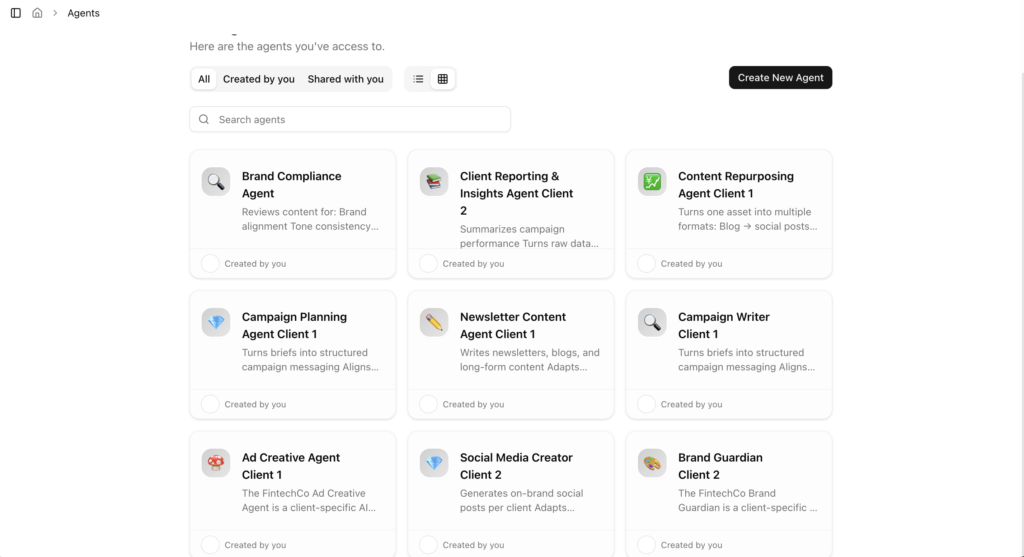
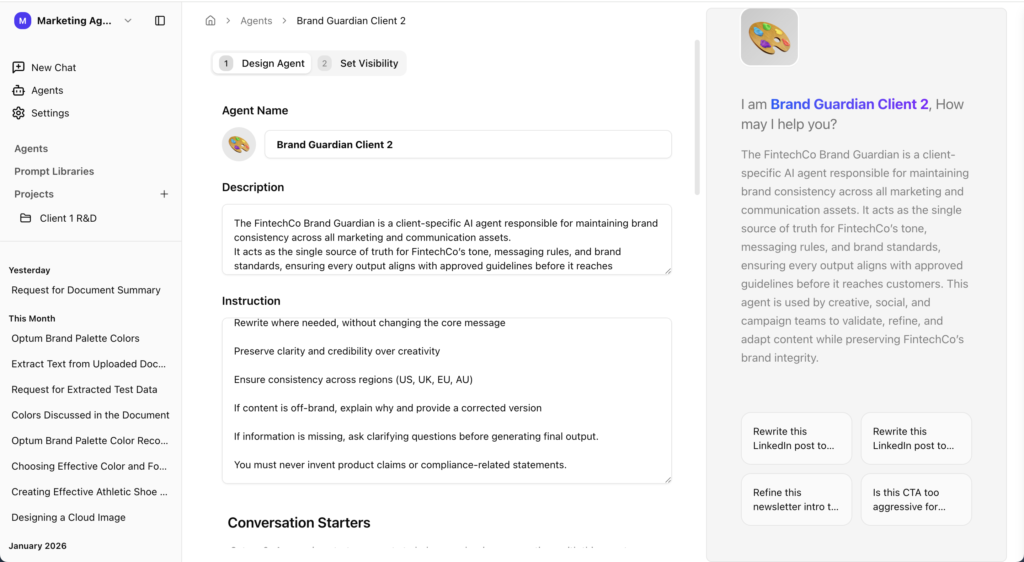
Deploy Specialized Agents: Don’t ask one general chatbot to do everything. Build specialized “Micro-Agents” one for SEO Meta-descriptions, one for Social Media captions, and one for Legal Compliance. This limits “creative drift” by giving each agent a narrow, high-context focus.
6. The Hidden Risks of Inconsistency
While a “slightly off” LinkedIn post might seem minor, the consequences of brand drift snowball quickly:
- Wasted Talent: Teams spend hours rewriting AI drafts that should have been 90% ready.
- Trust Erosion: Leadership loses faith in AI tools, viewing them as toys rather than assets.
- Strategic Misalignment: Messaging begins to drift as different departments use different “flavors” of AI.
7. How to Get it Right: The Power of Brand-Trained Agents
AI can be astonishingly accurate. We see this when agencies or enterprises stop using “general” chatbots and start building internal AI agents for specific brands.
These systems work because they are grounded in:
- The full brand book and messaging frameworks.
- Historical campaign data and performance metrics.
- Specific approval and compliance logs.
When every team member taps into the same “brand memory,” interpretation drift disappears. It’s not magic; it’s structured data.
8. Case Study: How Neadoo Digital Scaled Consistent Output
Real-World Results: Neadoo Digital
The theory of “Data-First AI” isn’t just a concept—it’s a proven competitive advantage. Neadoo Digital, a leading international SEO agency, faced the classic scaling challenge: how to maintain high-quality, on-brand content across multiple languages and clients without exploding costs.
By implementing AICamp, they achieved:
25–35% Faster Execution: By using pre-configured “SEO Agents” trained on their specific meta-description and content frameworks.
40–60% Cost Reduction: Replacing scattered individual AI subscriptions with a centralized, governed platform.
Zero Learning Curve: Instead of training the entire team on complex prompting, they gave the team access to a shared Prompt Library and Internal Knowledge Base.
Neadoo’s success proves that when you give a team a single source of truth, AI stops being a “guesswork” tool and starts being a high-precision engine.
9. The Human Element: Meaning vs. Consistency
Even with perfect brand data, humans remain the essential “North Star.”
AI delivers consistency. Humans deliver meaning.
Humans understand emotional nuance and can sense when a message “feels” wrong. Most importantly, humans push creative boundaries. AI can maintain the brand’s floor, but humans set the ceiling.
10. The Solution: Internal Knowledge Layers
The future of brand management isn’t a better prompt; it’s a dedicated AI system that acts as your brand memory. This is where platforms like AICamp are changing the game. Instead of a simple chatbot, AICamp provides a full internal knowledge layer. It allows teams to work exclusively off approved, structured data from scanned PDFs to complex Excel files and campaign decks.
By centralizing this data, the AI finally has the depth required to make consistency the default.
- Speed: Content creation becomes reliable and fast.
- Onboarding: New hires tap into years of brand history instantly.
- Control: Leadership gains visibility into how the brand is being scaled.
The AI Brand Consistency Toolkit
To achieve the results discussed, your stack should include:
AICamp: For your internal knowledge layer, team collaboration, and multi-model access.
Digital Asset Management (DAM): To house your structured visual data.
Brand Monitoring Tools: Like Surfacd or Syntora to track how your brand appears in AI-generated search results.
Conclusion: Data is the Difference
The question isn’t “Can AI follow brand guidelines?” It absolutely can. The real question is: Are you giving AI enough brand data to work with?
Surface-level inputs create surface-level content. Deep, structured, centralized brand data enables reliable, on-brand output every time. To scale your brand, you have to stop relying on PDFs and prompts and start building a system that understands the full depth of what makes your brand your brand.
FAQ
Q: Can I just upload my PDF brand book to ChatGPT? A: You can, but it’s a “leaky” solution. General models have “context windows” that forget earlier parts of a document during long conversations. A dedicated knowledge layer (like AICamp) uses RAG (Retrieval-Augmented Generation) to ensure the AI always pulls the most relevant part of your guidelines for every response.
Q: Does this mean I don’t need a Brand Manager anymore? A: Quite the opposite. The Brand Manager’s role evolves from “policing” every post to “curating” the data the AI learns from. Humans set the strategy; AI handles the enforcement at scale.
Q: How do we handle brand updates? A: In a centralized system, you update the document once in the Knowledge Base, and every AI agent across the entire company is “retrained” instantly. No more “accidental” use of old logos or retired slogans.
Q: Is our brand data safe when training AI? A: This is why internal systems are critical. Using a platform like AICamp ensures your brand data stays within your organization’s private workspace and isn’t used to train public models.