

Claude Enterprise is Anthropic’s answer for organizations that need safe, long‑context AI at scale, with enterprise‑grade security and compliance. It’s a strong choice if you want Claude as your primary model and your top priority is responsible AI behavior.
However, many teams now need more than a single‑vendor setup: they want multi‑model options, deeper workflow and agent capabilities, closer alignment with their existing ecosystems (Microsoft, Google, AWS), or more flexible pricing and deployment. That’s where Claude Enterprise alternatives come in.
TL;DR
In a hurry? Here are the top Claude Enterprise alternatives and what they’re best for:
- AICamp – Best overall for SMEs that want multi‑model, governed AI rollout across teams
- ChatGPT Enterprise – Best if you’re already heavily invested in OpenAI’s ecosystem
- Microsoft Copilot – Best for Microsoft 365‑centric organizations
- Google Gemini Enterprise/Team – Best for Google Workspace‑centric organizations
- Langdock – Best for EU‑first, workflow‑centric AI workspaces
- Dust – Best for teams that want multi‑model AI agents connected to internal tools & data
- Perplexity Enterprise – Best for research‑heavy, information‑seeking teams
- Amazon Q Business – Best for AWS‑centric organizations and engineering teams
What is Claude Enterprise?
Claude Enterprise is the enterprise edition of Anthropic’s Claude models, designed for large organizations that need high safety, long context windows, and robust security/compliance. It adds enterprise features like SSO, admin controls, usage visibility, and contractual assurances on data handling, wrapped around powerful Claude models.
It’s especially attractive for regulated industries and use cases where safe behavior, controllability, and long‑document understanding matter more than multi‑model experimentation.
Why You Should Look for Alternatives to Claude Enterprise
Reasons to explore alternatives include:
- Single‑vendor limitation – You only get Claude; if you want the freedom to combine Claude with GPT , Gemini, or open‑source LLMs, a multi‑model platform is more suitable.
- Workflow and agents – If your main need is agent‑style automation across tools, or deep workflow builders, you may want something more workflow‑centric.
- Ecosystem alignment – If your organization is built around Microsoft 365, Google Workspace, or AWS, those ecosystems’ native tools (plus a rollout platform) might fit better.
- Cost and scope – For small and mid‑sized teams, a heavyweight enterprise contract can be overkill; lighter, more flexible platforms are often easier to start with.
Comparison Table: Claude Enterprise Alternatives
| Alternative | Best for | Key strength | Multi‑model support | Pricing (high level) |
|---|---|---|---|---|
| AICamp | SMEs rolling out AI across multiple teams | Multi‑model, governed AI rollout with agents & projects | Yes + BYO | $12/user/month – BYOM $20/user/month – AICamp offered model |
| ChatGPT Enterprise | Orgs standardizing on OpenAI | Enterprise‑grade GPT with privacy & admin controls | GPT‑only | Premium per‑user enterprise pricing ($90/user/month) |
| Microsoft Copilot | Microsoft 365‑centric organizations | Embedded in Word, Excel, Outlook, Teams | Microsoft GPT stack | Copilot add‑on per M365 user |
| Google Gemini Enterprise/Team | Google Workspace‑centric orgs | Gemini inside Docs, Sheets, Slides, Gmail | Gemini‑only | Workspace + Gemini add‑on |
| Langdock | EU/data‑sensitive orgs with workflow needs | EU‑first AI workspace with assistants & workflows | Yes (curated) | $29/user/month – Included $22/user/month – BYOM + |
| Dust | Product/ops/eng teams building AI agents on company data | Multi‑model agents + deep integrations | Yes (curated set) | Pro per‑user; enterprise custom |
| Perplexity Enterprise | Research‑heavy and analyst teams | Research‑first, citation‑rich conversational search | Yes (under‑the‑hood) | Enterprise per‑user pricing |
| Amazon Q Business | AWS‑centric orgs & engineering teams | AWS‑native assistant with 40+ data connectors | Mainly AWS models | Lite $3, Pro $20/user/mo + index costs |
1. AICamp – Best Overall for Multi‑Model, Governed Rollout
What is AICamp?
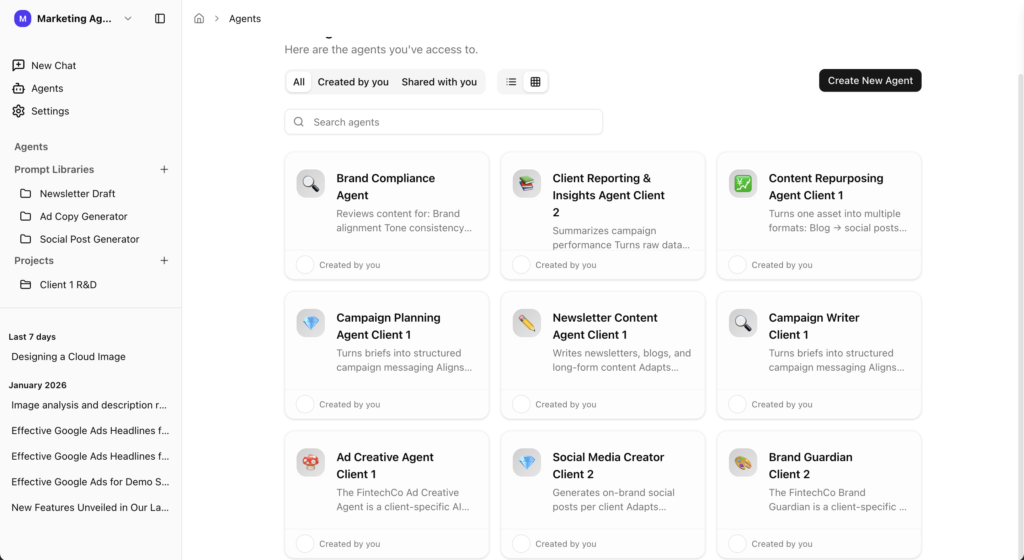
AICamp is an AI rollout platform aimed at small and mid‑sized enterprises that want multi‑model access, governance, and collaboration in a single place. It lets you plug in top commercial LLMs and your own models, then build projects, agents, and knowledgebases on top.
AICamp Features
- Multi‑model catalog plus bring‑your‑own APIs/LLMs
- Chat with memory, multimodel selector, file upload/OCR, data analysis, web search
- Projects, reusable AI agents, prompt libraries, internal knowledgebases
- Role‑based access control, per‑group model policies, SSO, guardrails, audit logs
- Dedicated cloud and on‑prem‑style deployments, with region controls
- Admin center, usage analytics, unified billing, bulk user management
- Team enablement and pilot programs for adoption
Best for
- Organizations that want Claude plus other models in one governed workspace.
- SMEs rolling out AI across many teams (not just a single department).
Advantages
- Multi‑model and BYOM prevent vendor lock‑in.
- Strong governance built‑in, comparable or stronger than many single‑model offerings.
- Designed explicitly for company‑wide rollout, not just a “better chat UI.”
Disadvantages
- Overpowered if you just want a single‑team Claude‑only deployment.
- Requires some upfront configuration (roles, policies) to realize full value.
Pricing
- Model‑included per‑user plans in the “$20/user/month” range.
- Lower BYOM tier when you pay model providers directly and use AICamp as the governance and workflow layer.( $12/user/month)
- Monthly and yearly options.
2. ChatGPT Enterprise – Best for OpenAI‑First Organizations
What is ChatGPT Enterprise?
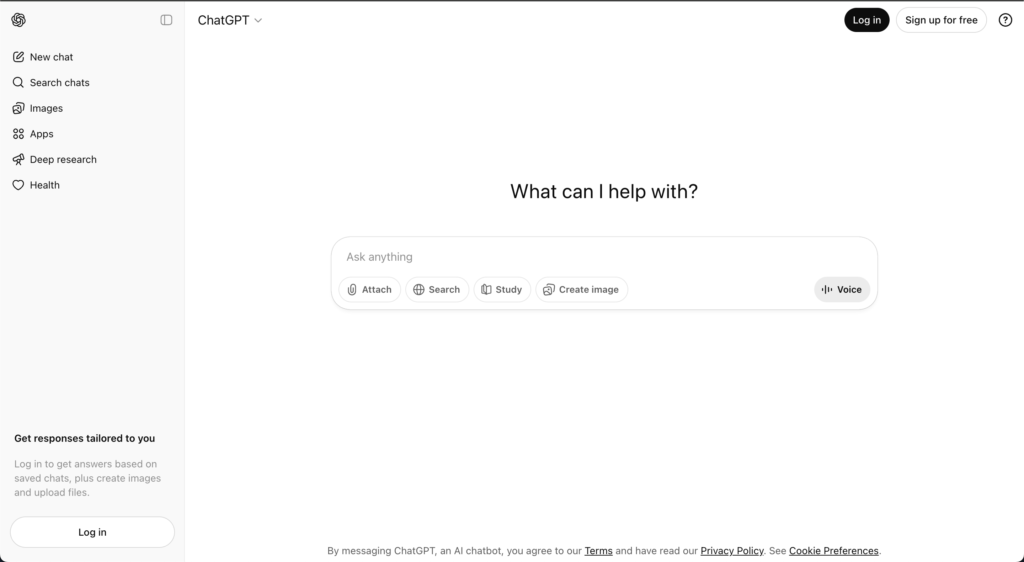
ChatGPT Enterprise is OpenAI’s enterprise offering for organizations that want GPT‑class models with stronger security, privacy, and admin features.
Features
- Access to advanced GPT models with higher limits and extended context
- SSO, admin console, usage analytics, and security/compliance assurances
- Centralized workspace for employees
Best for
- Organizations committed to OpenAI as their primary model vendor.
- Teams whose workflows are already built around GPT.
Advantages
- Very mature and widely adopted model stack.
- Strong privacy assurances and enterprise‑oriented SLAs.
Disadvantages
- Single‑vendor (GPT‑only); no native multi‑model or BYOM.
- Less focused on workflows and agents than some alternatives.
3. Microsoft Copilot – Best Inside Microsoft 365
What is Microsoft Copilot?
Microsoft Copilot brings AI into Microsoft 365 apps Word, Excel, PowerPoint, Outlook, Teams so users get AI assistance directly in the tools they already use.
Features
- Drafting and summarization in Word and Outlook
- Data exploration and analysis help in Excel
- Slide generation and editing in PowerPoint
- Meeting summaries and Q&A in Teams
- Admin and security management via Microsoft 365
Best for
Organizations standardized on Microsoft 365 that want AI built into their existing workflows.
Advantages
- Minimal behavior change for users; no extra app to learn.
- Strong enterprise security and compliance through the Microsoft stack.
Disadvantages
- Limited as a dedicated AI rollout platform or agent workspace.
- You may still need a separate multi‑model orchestration or governance layer.
4. Google Gemini Enterprise/Team – Best Inside Google Workspace
What is Gemini Enterprise/Team?
Gemini Enterprise/Team brings Google’s Gemini models into Docs, Sheets, Slides, Gmail, and a chat interface for Workspace users.
Features
- AI writing and summarizing in Docs and Gmail
- Data assistance in Sheets; presentation help in Slides
- Gemini chat for brainstorming and research
- Managed via Google Workspace admin
Best for
Organizations that live inside Google Workspace and want AI where they already work.
Advantages
- Deep integration with Google apps and ecosystem.
- Smooth adoption for existing Workspace users.
Disadvantages
- Gemini‑only; lacks multi‑vendor flexibility.
- Not a full agent/workflow platform by itself.
4. Langdock – Best for EU‑First Workspaces & Workflows
What is Langdock?
Langdock is an enterprise AI platform focused on secure AI adoption, especially attractive to European and data‑sensitive organizations. It offers workspaces with chat, assistants, agents, search, and integrations, with strong data residency and sovereignty options.
Key Features
- AI workspace with chat, assistants, and agents
- Integrations with tools like Slack, Google Drive, Confluence, and others
- Workflow builders and API options for more complex automations
- EU‑first hosting options, with attention to data residency and privacy
Advantages
- Best for: Organizations that need EU‑centric hosting, data sovereignty, and workflow‑oriented AI.
- Strong workspace metaphor for internal AI assistants and knowledge access.
- Good fit when compliance and hosting location are high priorities.
Disadvantages
- Pricing and complexity can ramp up as you add workflows and scale users.
- May be more than you need if you’re a small team just getting started.
Pricing
Per‑user business plans with additional tiers for workflows and API usage; total cost depends on seat count and usage level.
6. Dust – Best for Multi‑Model AI Agents on Company Data
What is Dust?
Dust is an AI workspace focused on building multi‑model AI agents that connect to your existing tools and data. Instead of just chat, you design agents that orchestrate models and external tools to complete tasks and workflows.
Key Features
- Support for multiple top models (such as GPT‑class, Claude‑class, Gemini, Mistral, etc.)
- Agent builder for multi‑step workflows and tool calls
- Integrations with Slack, Notion, Google Drive, GitHub and more
- Private spaces/workspaces with access controls for teams
Advantages
- Best for: Product, operations, and engineering teams that want agents to act across internal tools and data.
- Powerful for building “living workflows” rather than isolated chat sessions.
- Multi‑model and integration‑centric design.
Disadvantages
- Requires you to think in terms of agents and workflows, not just chat.
- Higher value for teams willing to invest time in building and iterating on agents.
Pricing
- Pro: per‑user subscription (around high‑20s/low‑30s EUR per user per month range).
- Enterprise: custom pricing for larger deployments with SSO and multiple workspaces.
7. Perplexity Enterprise – Best for Research‑Heavy Teams
What is Perplexity Enterprise?
Perplexity Enterprise is a research‑first, conversational search and answer platform for organizations. It combines LLMs with web and internal data sources to deliver grounded, citation‑rich answers rather than purely generative chat.
Key Features
- Conversational search over the web and, in enterprise offering, over your internal data
- Source‑linked answers with citations and supporting documents
- Team and enterprise features like SSO, admin controls, and usage analytics
- Focus on fast, accurate research and knowledge discovery
Advantages
- Best for: Research‑heavy teams (analysts, consultants, product, strategy) who care about sources and evidence.
- Reduces hallucinations by grounding answers in citations and real documents.
- Strong fit as a complement to generative‑first tools.
Disadvantages
- More focused on research and Q&A than workflow automation or agents.
- You may still want a separate platform for generative content and agent‑style workflows.
Pricing
Per‑user enterprise pricing, typically at a premium relative to individual Pro plans.
8. Amazon Q Business – Best for AWS‑Heavy Organizations
What is Amazon Q Business?
Amazon Q Business is AWS’s enterprise AI assistant for business users, built to plug into your AWS environment and a wide range of third‑party systems. It gives users natural‑language access to documentation, systems, and data, with a particular focus on AWS‑centric organizations.
Key Strengths
- Best for: AWS‑centric organizations, engineering teams, and enterprises that already run heavily on AWS.
- Deep AWS Infrastructure‑as‑Code assistance: helps with CloudFormation templates, service queries, deployment optimization.
- 40+ managed data connectors (Salesforce, ServiceNow, Zendesk, Jira, SharePoint, Confluence, GitHub, S3, and more).
- Permission‑aware search that respects IAM Identity Center and app‑level permissions.
- Amazon Q Apps: convert conversations into reusable, no‑code mini‑apps for repetitive workflows.
- Visual extraction of complex documents (PDFs, PowerPoints, Word, Google Docs) including charts and diagrams.
- Strong deployment flexibility: works in Slack, Teams, Outlook, Word, browser extensions, and web apps.
- Comprehensive security and compliance (e.g., SOC, HIPAA, PCI, ISO‑family certifications).
- Documented productivity gains (e.g., significant reductions in onboarding time and case‑handling time in customer case studies).
Limitations
- Accuracy concerns: some internal and external commentary has noted that Q Business has lagged top competitors on answer quality in certain scenarios.
- Struggles with tabular data: spreadsheet‑style analysis can be weaker than alternatives.
- Conversation memory limitations: can lose context across longer multi‑turn interactions.
- Complex setup for non‑AWS data sources: configuring systems like SharePoint can be time‑consuming.
- Limited value if you are not AWS‑centric: the real power comes when you are already on AWS.
- Index‑based pricing can be tricky: you pay user fees plus hourly index costs, which can be non‑trivial at scale.
Pricing
- Lite: about $3/user/month.
- Pro: about $20/user/month.
- Additional index pricing on top: Starter around $0.140/hour per index unit, Enterprise around $0.264/hour per unit.
Conclusion
Claude Enterprise is an excellent option when you want a safety‑first, long‑context model at scale. But it’s far from your only choice. If you need multi‑model flexibility, ecosystem‑native experiences (Microsoft, Google, AWS), stronger workflow/agent capabilities, or a more SME‑friendly rollout platform, the alternatives above can offer a better fit.
AICamp stands out as the most balanced, multi‑model, governance‑focused alternative for small and mid‑sized enterprises. ChatGPT Enterprise, Copilot, Gemini, and Amazon Q cover the major ecosystem‑native options. Langdock, Dust, and Perplexity Enterprise fill out specialized needs around EU hosting, agents, and research‑first experiences.
The best approach is to map your requirements (models, ecosystem, governance, use cases) and run pilot projects with 2–3 of these tools. That will give you a clearer view of where Claude Enterprise fits and where an alternative might unlock more value for your organization.
FAQs: Claude Enterprise Alternatives
1. Who is Claude Enterprise best suited for?
Claude Enterprise is best for large organizations that want Claude as their primary model, especially in regulated or safety‑sensitive industries where long‑context reasoning and responsible behavior are top priorities.
2. When should I consider an alternative to Claude Enterprise?
You should look at alternatives when you need multi‑model flexibility, stronger workflow or agent capabilities, closer integration with your existing stack (Microsoft, Google, AWS), or a rollout approach that’s more SME‑friendly in terms of cost and complexity.
3. What is the best overall alternative to Claude Enterprise for SMEs?
AICamp is the strongest overall option for small and mid‑sized enterprises because it’s built as a multi‑model, governed AI rollout platform with projects, agents, and knowledgebases that can span the entire organization.
4. Can I still use Claude if I move off Claude Enterprise?
Yes. Multi‑model platforms like AICamp or agent platforms like Dust can continue to use Claude alongside other models, and open‑source front‑ends such as LibreChat or OpenWebUI can be configured to talk to Claude APIs where your licensing allows.
5. How does AICamp differ from Claude Enterprise in practice?
Claude Enterprise gives you a Claude‑only enterprise environment, while AICamp gives you a governed workspace across multiple models, with built‑in projects, agents, and knowledgebases designed for broad organizational rollout rather than a single‑model deployment.
6. Should I choose an ecosystem‑native tool like Copilot, Gemini, or Amazon Q instead?
If most of your work lives in Microsoft 365, Google Workspace, or AWS, ecosystem‑native tools can be a great first layer because they put AI directly into existing apps. Many organizations still add a separate rollout or agent platform to gain multi‑model flexibility and centralized governance.
7. Are open‑source tools like LibreChat viable alternatives for non‑technical companies?
Open‑source tools are powerful but usually better for engineering‑heavy organizations, because they require you to handle hosting, security, and governance yourself. Non‑technical companies typically pair them with—or choose instead—a managed platform.
8. Where does Perplexity Enterprise fit among Claude Enterprise alternatives?
Perplexity Enterprise is a strong complement when your main need is research and information discovery with citations. It’s often used alongside a generative or agent‑focused platform rather than as a complete replacement for Claude Enterprise.
9. What’s the biggest risk of staying single‑vendor with Claude Enterprise or ChatGPT Enterprise?
The main risk is vendor lock‑in: you’re tied to one pricing model, one roadmap, and one model family. Multi‑model platforms let you pick the best model per use case and switch more easily as the landscape evolves.
10. How should we practically evaluate Claude Enterprise versus its alternatives?
Define 5–10 real workflows, then run a short pilot (30–60 days) with Claude Enterprise and 1–2 alternatives. Compare accuracy, user adoption, governance fit, integration effort, and total cost of ownership, not just raw model quality.