

ChatGPT Enterprise has become a default choice for many organizations that want secure, high‑performance access to OpenAI models with enterprise‑grade privacy and admin controls. It works well if you’re comfortable standardizing on a single vendor and primarily need a powerful chat and assistant layer for knowledge workers.
But as AI adoption matures, many teams now want more: multi‑model flexibility, deeper governance, closer integration with existing ecosystems (Microsoft, Google, AWS), agent‑style workflows, or more specialized features like marketing collaboration or engineering‑centric assistants. That’s where alternatives to ChatGPT Enterprise start to offer a better fit.
TL;DR
In a hurry? Here are the top ChatGPT Enterprise alternatives and what they’re best for:
- AICamp – Best for SMEs that need multi‑model, governed AI rollout across teams
- Microsoft Copilot – Best for Microsoft 365‑centric organizations
- Claude Enterprise – Best for enterprises that prioritize safety and long‑context work
- Langdock – Best for European or data‑sensitive orgs that want EU‑first, workflow‑centric AI workspaces
- Juma – Best for marketing teams and agencies that want a dedicated AI workspace
- Dust – Best for teams that want multi‑model AI agents connected to internal tools & data
- LibreChat – Best for engineering‑heavy, open‑source‑first companies
- Perplexity Enterprise – Best for research‑heavy, information‑seeking teams
- Amazon Q Business – Best for AWS‑centric organizations and engineering teams
What is ChatGPT Enterprise?
ChatGPT Enterprise is OpenAI’s enterprise‑grade version of ChatGPT that adds stronger privacy, admin, and security controls on top of its flagship models. It gives organizations a centralized workspace with SSO, usage analytics, higher limits, and contractual assurances (like data not being used to train models by default).
It’s a strong option when you want “ChatGPT, but safe for the whole company,” and you’re comfortable building processes and workflows around a single vendor’s models.
Why You Should Look for Alternatives to ChatGPT Enterprise
You might explore alternatives when:
- You want multi‑model rather than a single‑vendor stack (for example, mixing OpenAI, Claude, Gemini, open‑source, or domain‑specific models).
- You need AI “inside” your existing ecosystem (Microsoft 365, Google Workspace, AWS) instead of in a separate workspace.
- You want agent‑style workflows with tools deeply wired into your data and systems, not only chat.
- You care about region/data residency, on‑prem, or EU‑first hosting in ways that point you toward specific platforms.
- You need more domain‑specific experiences, like marketing‑only workspaces or research‑first interfaces.
Comparison Table: Top ChatGPT Enterprise Alternatives
| Alternative | Best for | Key strength | Multi‑model support | Pricing (high level) |
|---|---|---|---|---|
| AICamp | SMEs rolling out AI across teams | Multi‑model, governed AI rollout platform with agents | Yes + BYO | $12/user/month – BYOM $20/user/month – AICamp offered model |
| Microsoft Copilot | Microsoft 365‑centric orgs | Deeply embedded in Office apps & Teams | Microsoft‑hosted GPT stack | Copilot add‑on per M365 user (~low‑30s/user/month) |
| Claude Enterprise | Safety‑ and compliance‑sensitive enterprises | Safety‑first, long‑context Claude models | Claude only | Custom enterprise pricing |
| Langdock | EU/data‑sensitive orgs needing workflows & assistants | EU‑first AI workspace with workflows and integrations | Yes (selected vendors) | $29/user/month – Included $22/user/month – BYOM + |
| Juma | Marketing teams & agencies | Marketing‑first AI workspace & collaboration | Yes (key vendors) | Custom ( ~$20/user/month – starting) |
| Dust | Product/ops/engineering teams wanting AI agents | Multi‑model AI agents with deep tool/data integrations | Yes (top models) | Pro per‑user; Enterprise custom |
| LibreChat | Engineering‑heavy, open‑source‑first organizations | Self‑hosted, open‑source chat interface | Yes (via APIs/backends) | Free software; infra + API costs |
| Perplexity Enterprise | Research‑heavy teams and knowledge workers | Research‑first, web‑grounded conversational search | Yes (under the hood) | Per‑user enterprise pricing |
| Amazon Q Business | AWS‑centric orgs & engineering teams | AWS‑native assistant with 40+ data connectors | Primarily AWS models | Lite $3/user/mo; Pro $20/user/mo + index hourly pricing |
List of ChatGPT Enterprise Alternatives
- AICamp
- Microsoft Copilot
- Claude Enterprise
- Langdock
- Juma
- Dust
- LibreChat
- Perplexity Enterprise
- Amazon Q Business
1. AICamp – Best for Multi‑Model, Governed Rollout
What is AICamp?
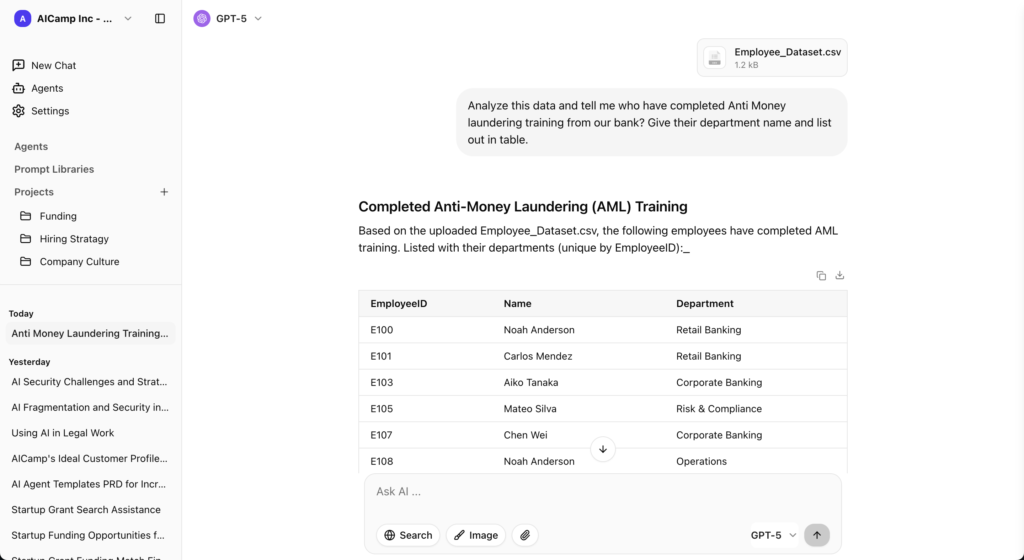
AICamp is an AI rollout platform for small and mid‑sized enterprises that want to give employees access to multiple models in a governed, structured way. Instead of being tied to a single model provider, you can plug in OpenAI‑class, Claude‑class, Gemini‑class, and even open‑source/custom LLMs under one workspace, with projects, agents, and knowledgebases on top.
Key Features
- Multi‑model support with a built‑in model catalog plus BYO APIs/LLMs
- Chat with memory, multimodel selector, file upload/OCR, data analysis, and web search
- Projects, reusable AI agents, prompt libraries, internal knowledgebases
- Role‑based access control, group‑level model policies, SSO, guardrails, audit logs
- Dedicated cloud or on‑prem‑style deployments with regional controls
- Admin center, usage dashboards, unified billing, bulk user management
- Team enablement and pilot programs to help with adoption
Advantages
- Best for: SMEs that want to roll out AI across multiple teams (product, support, marketing, ops, etc.).
- Multi‑model and BYOM keep you flexible as new models appear or pricing changes.
- Strong governance features give you more control than a basic chat‑only environment.
Disadvantages
- More platform than you need if you just want “one good chatbot” for a small team.
- Requires some upfront configuration (roles, model policies, guardrails) to get the most value.
Pricing
- Model‑included per‑user plans in the “$20/user/month” range.
- Lower BYOM tier when you pay model providers directly and use AICamp as the governance and workflow layer.( $12/user/month)
- Monthly and yearly options.
2. Microsoft Copilot – Best for Microsoft 365 Organizations
What is Microsoft Copilot?
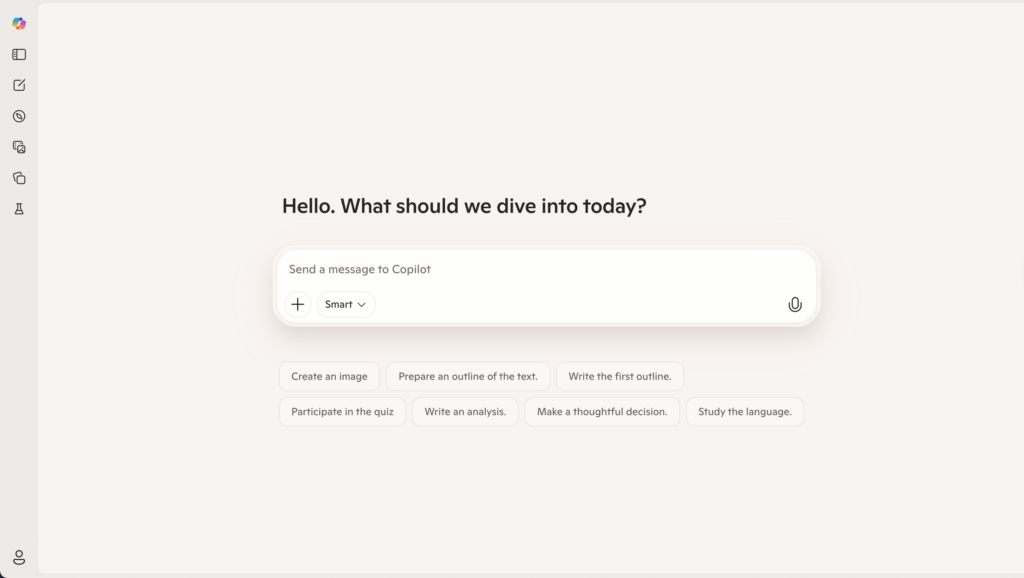
Microsoft Copilot is Microsoft’s AI companion embedded across the Microsoft 365 suite—Word, Excel, PowerPoint, Outlook, Teams—and increasingly within Windows and other Microsoft products. It augments everyday work with drafting, summarizing, and data‑handling capabilities.
Key Features
- Drafting, rewriting, and summarization in Word and Outlook
- Data analysis, formula help, and insight suggestions in Excel
- Presentation creation and editing in PowerPoint
- Meeting summaries, action items, and Q&A in Teams
- Admin controls through Microsoft 365 admin center; policy and security integration
Advantages
- Best for: Organizations that already live inside Microsoft 365 and want AI where people already work.
- Strong enterprise security/compliance posture aligned with Microsoft’s ecosystem.
- Low friction for adoption: no new separate app to push to users.
Disadvantages
- Not a full AI rollout platform: limited agents, multi‑model routing, or cross‑tool AI governance.
- Less suitable for highly specialized AI workflows that need dedicated workspaces, agents, or multi‑model orchestration.
Pricing
Sold as a Copilot add‑on per Microsoft 365 user; many business plans are in the low‑30s USD per user per month.
3. Claude Enterprise – Best for Safety & Long‑Context Work
What is Claude Enterprise?
Claude Enterprise is Anthropic’s enterprise‑grade offering, bringing Claude models to organizations that need robust safety, long context windows, and enterprise security/compliance. It’s designed for large deployments where Claude is the primary model of choice.
Key Features
- Access to Claude models with extended context windows
- Enterprise‑grade security, compliance, and data handling
- SSO, admin controls, and integration routes into internal tools
- Suitable for document‑heavy and safety‑critical workflows
Advantages
- Best for: Enterprises that care deeply about safety, alignment, and long‑context tasks (e.g., legal, policy, research).
- Strong assurances around model behavior and responsible AI.
- Ideal if you’ve already standardized on Claude or plan to.
Disadvantages
Single‑vendor (Claude only); no direct multi‑model routing.
For broader multi‑model or agent‑heavy workflows, you’ll often pair it with separate orchestration layers or platforms.
Pricing
Custom enterprise contracts with per‑seat or usage‑based pricing tailored to each customer.
4. Langdock – Best for EU‑First Workspaces & Workflows
What is Langdock?
Langdock is an enterprise AI platform focused on secure AI adoption, especially attractive to European and data‑sensitive organizations. It offers workspaces with chat, assistants, agents, search, and integrations, with strong data residency and sovereignty options.
Key Features
- AI workspace with chat, assistants, and agents
- Integrations with tools like Slack, Google Drive, Confluence, and others
- Workflow builders and API options for more complex automations
- EU‑first hosting options, with attention to data residency and privacy
Advantages
- Best for: Organizations that need EU‑centric hosting, data sovereignty, and workflow‑oriented AI.
- Strong workspace metaphor for internal AI assistants and knowledge access.
- Good fit when compliance and hosting location are high priorities.
Disadvantages
- Pricing and complexity can ramp up as you add workflows and scale users.
- May be more than you need if you’re a small team just getting started.
Pricing
Per‑user business plans with additional tiers for workflows and API usage; total cost depends on seat count and usage level.
5. Juma – Best for Marketing Teams & Agencies
What is Juma?
Juma (formerly Team‑GPT) is a collaborative AI workspace built specifically for marketing teams and agencies. It focuses on marketing workflows such as campaign planning, content creation, and performance analysis, rather than generic company‑wide AI.
Key Features
- Shared workspaces for marketing campaigns and content
- AI‑assisted ideation, copywriting, and repurposing across channels
- Integrations with marketing tools and document sources
- Collaboration features tailored to marketing teams
Advantages
- Best for: Marketing teams and agencies that want AI deeply woven into their marketing workflow.
- Provides more out‑of‑the‑box marketing structure than a general chat platform.
- Great complement to a broader AI rollout stack.
Disadvantages
- Not designed as a full, organization‑wide AI platform.
- You’ll probably need another tool to serve non‑marketing functions.
Pricing
Tiered, marketing‑tool‑style pricing (per user or per workspace), with details typically available on its pricing page or via sales.
6. Dust – Best for Multi‑Model AI Agents on Company Data
What is Dust?
Dust is an AI workspace focused on building multi‑model AI agents that connect to your existing tools and data. Instead of just chat, you design agents that orchestrate models and external tools to complete tasks and workflows.
Key Features
- Support for multiple top models (such as GPT‑class, Claude‑class, Gemini, Mistral, etc.)
- Agent builder for multi‑step workflows and tool calls
- Integrations with Slack, Notion, Google Drive, GitHub and more
- Private spaces/workspaces with access controls for teams
Advantages
- Best for: Product, operations, and engineering teams that want agents to act across internal tools and data.
- Powerful for building “living workflows” rather than isolated chat sessions.
- Multi‑model and integration‑centric design.
Disadvantages
- Requires you to think in terms of agents and workflows, not just chat.
- Higher value for teams willing to invest time in building and iterating on agents.
Pricing
- Pro: per‑user subscription (around high‑20s/low‑30s EUR per user per month range).
- Enterprise: custom pricing for larger deployments with SSO and multiple workspaces.
7. LibreChat – Best for Open‑Source, Self‑Hosted Control
What is LibreChat?
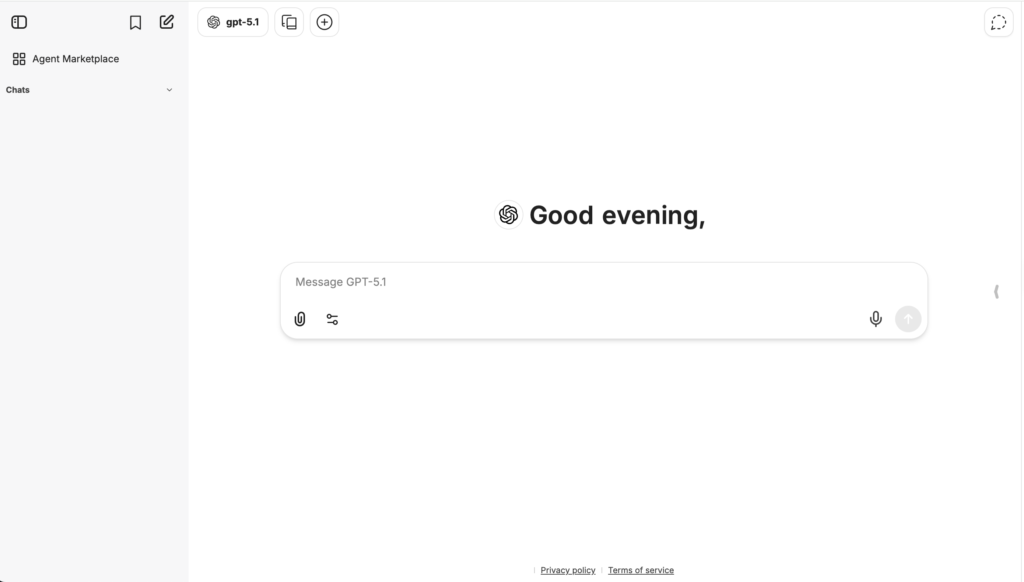
LibreChat is an open‑source, self‑hosted chat UI that sits on top of multiple LLM backends. It’s aimed at teams that want maximum control over infrastructure, models, and data, and are comfortable self‑hosting.
Key Features
- Web‑based chat interface for multiple LLMs via APIs
- Support for different backends (commercial APIs, open‑source models, or your own)
- Configurable environment and custom extensions through code
Advantages
- Best for: Engineering‑heavy organizations that prefer open‑source and self‑hosting.
- No per‑user license fees; you’re paying mostly infra and API costs.
- Highly customizable to your stack and security model.
Disadvantages
- No out‑of‑the‑box enterprise governance, guardrails, or end‑user enablement.
- Requires engineering to deploy, maintain, secure, and integrate.
Pricing
Software is free and open‑source; cost comes from hosting and model/API usage.
8. Perplexity Enterprise – Best for Research‑Heavy Teams
What is Perplexity Enterprise?
Perplexity Enterprise is a research‑first, conversational search and answer platform for organizations. It combines LLMs with web and internal data sources to deliver grounded, citation‑rich answers rather than purely generative chat.
Key Features
- Conversational search over the web and, in enterprise offering, over your internal data
- Source‑linked answers with citations and supporting documents
- Team and enterprise features like SSO, admin controls, and usage analytics
- Focus on fast, accurate research and knowledge discovery
Advantages
- Best for: Research‑heavy teams (analysts, consultants, product, strategy) who care about sources and evidence.
- Reduces hallucinations by grounding answers in citations and real documents.
- Strong fit as a complement to generative‑first tools.
Disadvantages
- More focused on research and Q&A than workflow automation or agents.
- You may still want a separate platform for generative content and agent‑style workflows.
Pricing
Per‑user enterprise pricing, typically at a premium relative to individual Pro plans.
9. Amazon Q Business – Best for AWS‑Heavy Organizations
What is Amazon Q Business?
Amazon Q Business is AWS’s enterprise AI assistant for business users, built to plug into your AWS environment and a wide range of third‑party systems. It gives users natural‑language access to documentation, systems, and data, with a particular focus on AWS‑centric organizations.
Key Strengths
- Best for: AWS‑centric organizations, engineering teams, and enterprises that already run heavily on AWS.
- Deep AWS Infrastructure‑as‑Code assistance: helps with CloudFormation templates, service queries, deployment optimization.
- 40+ managed data connectors (Salesforce, ServiceNow, Zendesk, Jira, SharePoint, Confluence, GitHub, S3, and more).
- Permission‑aware search that respects IAM Identity Center and app‑level permissions.
- Amazon Q Apps: convert conversations into reusable, no‑code mini‑apps for repetitive workflows.
- Visual extraction of complex documents (PDFs, PowerPoints, Word, Google Docs) including charts and diagrams.
- Strong deployment flexibility: works in Slack, Teams, Outlook, Word, browser extensions, and web apps.
- Comprehensive security and compliance (e.g., SOC, HIPAA, PCI, ISO‑family certifications).
- Documented productivity gains (e.g., significant reductions in onboarding time and case‑handling time in customer case studies).
Limitations
- Accuracy concerns: some internal and external commentary has noted that Q Business has lagged top competitors on answer quality in certain scenarios.
- Struggles with tabular data: spreadsheet‑style analysis can be weaker than alternatives.
- Conversation memory limitations: can lose context across longer multi‑turn interactions.
- Complex setup for non‑AWS data sources: configuring systems like SharePoint can be time‑consuming.
- Limited value if you are not AWS‑centric: the real power comes when you are already on AWS.
- Index‑based pricing can be tricky: you pay user fees plus hourly index costs, which can be non‑trivial at scale.
Pricing
- Lite: about $3/user/month.
- Pro: about $20/user/month.
- Additional index pricing on top: Starter around $0.140/hour per index unit, Enterprise around $0.264/hour per unit.
Conclusion
ChatGPT Enterprise is a strong baseline for many organizations, but it’s not the only way or always the best way to deploy AI at scale. If you want multi‑model flexibility, stronger governance, or deeper ecosystem integration, alternatives like AICamp, Microsoft Copilot, Claude Enterprise, Langdock, Juma, Dust, LibreChat, Perplexity Enterprise, and Amazon Q Business offer different strengths.
AICamp stands out as the most balanced, best‑overall alternative for small and mid‑sized enterprises that need governed, multi‑model rollout across teams. Copilot and Gemini shine when you’re committed to Microsoft or Google. Claude Enterprise and Perplexity Enterprise are compelling for safety‑ and research‑first use cases. Amazon Q Business is the natural choice if you’re deeply on AWS, while Juma, Dust, and open‑source tools cover marketing‑first, agent‑first, and self‑hosted scenarios.
The right move is to shortlist two or three tools that fit your stack and risk profile, run a 30–60‑day pilot, and compare user adoption, accuracy, and total cost rather than assuming ChatGPT Enterprise is the only enterprise‑grade option.